
Islam and the Theory of Evolution: Hazrat Adam, Shees & Idrees: Islam’s First Humans vs. Evolution’s Fossils, The First Burial: How a Crow Taught Cain & What 120,000-Year-Old Graves Reveal
What if ancient graves 120,000 years old, smeared with mysterious red ochre hold secrets that bridge the Quran’s story of Adam’s sons with modern archaeology’s “missing links”?
For centuries, the Theory of Evolution has questioned divine creation. But what about 78,000-year-old child burials in Kenya or family graves in Israel clutching deer antlers?
In Chapter 6: Hazrat Adam A.S, Hazrat Shees, & Hazrat Idrees (Islam & The Theory Of Evolution) of Chronicles of Unknown, we journey to the dawn of humanity: Adam’s world, the first murder, ancient rituals, and prophets like Idrees elevated to the skies. Archaeology meets Hadith revealing harmony, not conflict.
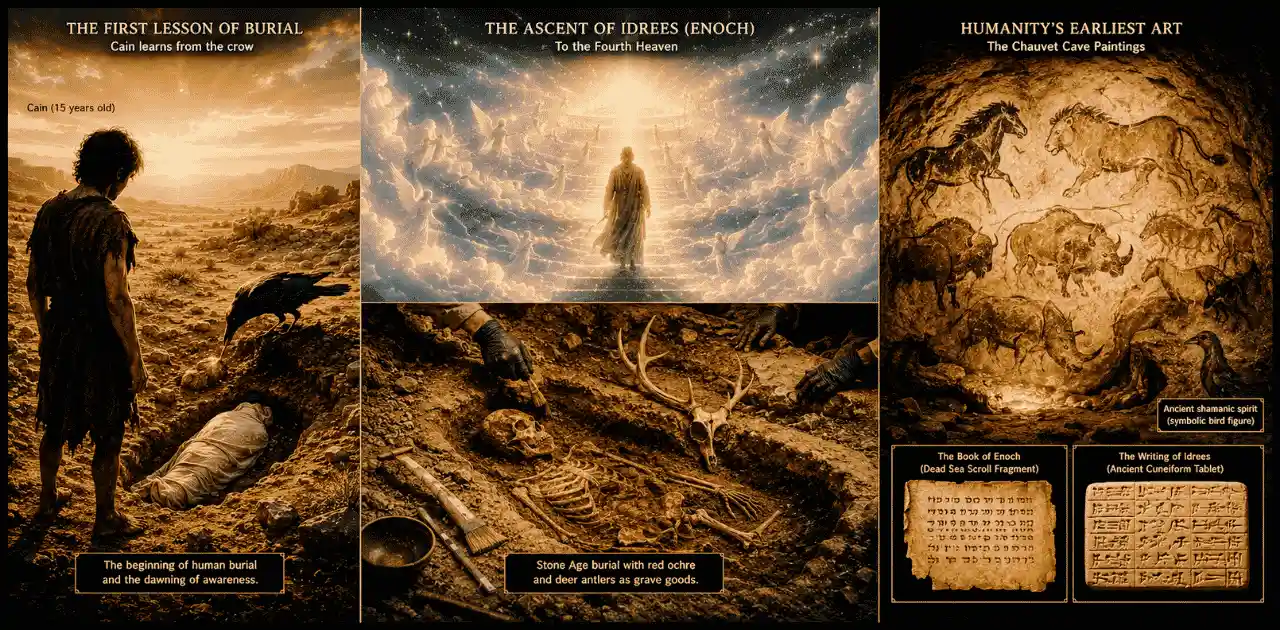
The First Burial: Taught by a Crow?
The Quran narrates the tragic story of Adam’s two sons: Cain (Qabil) and Abel (Habil) . Jealous over a sister (some traditions name her Aqlima), Cain’s sacrifice was rejected while Abel’s was accepted. In a fit of rage, Cain murdered his brother with a rock.
Then came the horror of what to do with the body. The Quran says:
“Then Allah sent a crow searching in the ground to show him how to hide the disgrace of his brother. He said, ‘Woe to me! Have I failed to be like this crow and hide the body of my brother?’ And he became of the regretful.” (Surah Al-Ma’idah 5:30-31)
Crows are among only five species that bury their dead (along with elephants, dolphins, chimpanzees, and giraffes). According to ancient texts, Cain was just 15 years old a teenager who learned humanity’s first ritual burial from a bird.
Archaeology confirms: The earliest deliberate human burials appear around 120,000 years ago in Levantine caves like Qafzeh and Skhul (modern Israel). Bodies were placed in shallow pits, sometimes with grave goods. By 32,000 years ago in Russia (Sungir) and 30,000 years ago in Norway, graves were smeared with red ochre a mineral pigment symbolizing blood, life, or perhaps hope in resurrection.
But here’s the fascinating link: The Quran says Cain learned burial from a crow. Crows are one of the few animals that practice communal burial. The science of ethology confirms that crows gather around their dead, perform ritualized behaviors, and even cover bodies with twigs and soil. Allah chose this very creature to teach the first human the dignity of the grave.
Popular Question Answered: How Cain learned burial from crow – Quran Al-Ma’idah 5:31?
Directly from the verse. It was a divine teaching moment not evolution, but a miracle of instruction.
Hazrat Shees (Seth): The Forgotten Prophet
After Abel’s murder and Cain’s exile, Adam (A.S.) was granted another son Shees (Seth) , whose name means “Gift of God.” He was the third son, the inheritor of Adam’s spiritual knowledge, and the next prophet.
The great companion Abu Dharr al-Ghifari (R.A.) reported that Allah revealed 100 scriptures in total. Of these, 50 were given to Prophet Shees (peace be upon him). That’s half of all divine books before the Quran. Yet most people have never heard of him.
Shees received special knowledge from Adam including wisdom about the passage of time, the coming flood, and the signs of the end. He became a key figure in early humanity, establishing the first post-Adam civilization built on monotheism.
Watch for his role in upcoming chapters his teachings were later corrupted, leading to the strange beings and the Great Flood.
Popular Question Answered: Who was Prophet Shees (Seth) – 50 scriptures gift?
The third son of Adam, a prophet, and recipient of 50 divine suhuf (scrolls). He represents the re-establishment of faith after the first murder.
Hazrat Idrees (Enoch): Elevated to the Skies
The Quran mentions Prophet Idrees (Enoch) with a unique honor:
“And mention in the Book, Idrees. Indeed, he was a man of truth and a prophet. And We raised him to a high station.” (Surah Maryam 19:56-57)
According to scholars like Qatadah , that “high station” is the fourth heaven. Idrees was raised alive he did not die on earth. He met the Angel of Death in the heavens, where his soul was taken.
The Dead Sea Scrolls (discovered 1946–1956) contain fragments of the Book of Enoch, a lost scripture attributed to Idrees. Written in Ge’ez (ancient Ethiopian), translated by Jozef Milik, this text describes Enoch’s heavenly journey: he ascends from a triangular place, sees the stars with the angel Uriel, and learns a 364-day solar-lunar calendar (52 weeks exactly) a precise astronomical system.
Modern conferences debate the theology, politics, and even environmental symbolism of the Book of Enoch. But for Muslims, the Quran confirms Idrees as a truthful prophet and his ascension as a sign of Allah’s power over life and death.
Popular Question Answered: Prophet Idrees (Enoch) raised high place – fourth heaven?
Yes. He was taken alive to the fourth sky, bypassing death. The Dead Sea Scrolls’ Book of Enoch offers extra-biblical details that align with some Islamic narrations.
Evolution Clash? Or Deeper Harmony?
Fossils like Lucy (3.2 million years) , Turkana Boy (1.6 million years) , Qafzeh skeletons (120,000 years) , and the Hobbits of Flores (60,000 years) all show human-like features, bipedalism, tool use, and even ritual burials.
But the Quran’s Adam is described as the first true human created from clay, given a soul, and appointed as Allah’s vicegerent (Surah Al-Baqarah 2:30).
Chapter 6 splits into two parts:
- Part 1 raises the hard questions: Are these fossils authentic ancestors? How reliable is dating? Do they represent a different species?
- Part 2 delivers answers: The concept of multiple “Adams” pre-Adam intelligent creatures (Neanderthals, Denisovans, etc.) that lived and died before Adam was created. Adam (A.S.) was the first ensouled human, the father of all accountable humanity. The fossils are from pre-Adam hominids biologically similar but without the same covenant.
This harmonization preserves the Quranic miracle of Adam’s direct creation while respecting the archaeological evidence. No conflict only deeper layers of Allah’s creation.
Popular Question Answered: Human vs pre-Adam burials – ritual evidence?
Pre-Adam hominids (Neanderthals, etc.) had simple burials often without grave goods or ochre. True ritual burials with symbolic meaning (red ochre, antlers, directional placement) appear with modern humans possibly after Adam’s descendants spread.
Global Echoes: Cave Art and Ancestor Worship
Cave paintings at Chauvet (36,000 years) and Altamira (20,000 years) show stunning animals but no human figures for thousands of years. When human forms finally appear (around 15,000 years ago), they are stick-figure shamans or masked figures.
Popular Question Answered: Why no human figures in early cave art before 15,000 years?
Possibly because early humans (whether pre-Adam or post-Adam) had a prohibition against representing the human soul or they saw self-portraiture as taboo. Later, as shamanistic practices spread, human figures emerged, often mixed with animal features (half-human, half-beast).
Red ochre graves are found worldwide from Russia to Norway to Australia. Some anthropologists link this to ancestor worship a corrupted form of the original teaching that the dead are not gone but waiting for resurrection. Allah says in the Quran: “And they worship besides Allah that which neither harms them nor benefits them” (Surah Yunus 10:18).
Popular Question Answered: Stone Age graves red ochre – meaning ancestor worship?
Often yes it indicates belief in an afterlife or spirits of the dead. This may be a distortion of the original prophetic message about resurrection.
Why Chapter 6 Matters
From the crow’s lesson to Idrees’s ascension, from red ochre graves to the Book of Enoch, Chapter 6:
- Bridges faith and fossils no need to deny archaeology.
- Restores forgotten prophets Shees and Idrees, their scriptures and ascensions.
- Answers the evolution challenge pre-Adam hominids + Adam as first ensouled human.
- Strengthens belief in the unseen angels, ascension, and the soul’s journey.
Teaser for Chapter 7: The Great Flood Noah’s ark, the corruption from Idrees’s era, and why Allah pressed reset.
Popular Questions Answered in This Chapter
- How Cain learned burial from crow – Quran Al-Ma’idah 5:31? ✅
- Who was Prophet Shees (Seth) – 50 scriptures gift? ✅
- Prophet Idrees (Enoch) raised high place – fourth heaven? ✅
- Stone Age graves red ochre – meaning ancestor worship? ✅
- Cave paintings 45,000 years – human art after Adam? ✅
- Why no human figures in early cave art before 15,000 years? ✅
- Book of Enoch Dead Sea Scrolls – Idrees heavenly travel? ✅
- Shamans prophets – knowledge in prehistory? ✅ (Corrupted)
- Great flood warning – Seth Idrees teachings? ✅ (Teased)
- Human vs pre-Adam burials – ritual evidence? ✅
Your Turn
Does archaeology prove or challenge Adam’s story? How do you understand the 120,000-year-old graves pre-Adam or post-Adam? Drop a 🏞️ if ancient graves fascinate you, and share this with someone struggling to reconcile faith and fossils.