Have you ever wondered who was the real Pharaoh during Prophet Musa’s (A.S.) time? Was it Ramesses II whose mummy still lies in Cairo, preserved as a sign for humanity? Or how an entire civilization became so obsessed with magic (jadoo) that they couldn’t distinguish it from science or religion?
In Chapter 13: Hazrat Musa, Pharaoh, Qadeem Misr, Jadoo of Chronicles of Unknown, we dive deep into the world of ancient Egypt where rivers held more power than pyramids, spells were whispered into coffins, and a tyrant ruler faced off against one of the greatest prophets in history.
This isn’t just history. It’s faith meeting archaeology. Quran meeting papyrus scrolls. Divine miracles confronting human illusions.
The Hidden Source of Pharaoh’s Power
Everyone talks about the pyramids (ahram) and massive statues. But the Quran reveals the true secret in Surah Az-Zukhruf:
“And Pharaoh proclaimed among his people, ‘O my people, is not the kingdom of Egypt mine, and these rivers flowing beneath me? Do you not then see?'” (Surah Az-Zukhruf 43:51)
It wasn’t stone monuments. It was the Nile River’s canal system an engineering marvel that turned Egypt into a superpower. The Nile fed armies, transported gold from Sudan, watered crops, and fueled the ego of 30 dynasties of pharaohs.
Popular Question Answered: What was the role of the Nile River in ancient Egyptian power?
The Nile was the lifeblood. Its predictable flooding created fertile soil. Pharaohs who controlled the canals controlled Egypt. That’s why Pharaoh boasted of “rivers flowing beneath my palaces” not pyramids.
When Magic Ruled Egypt
Ancient Egyptians didn’t see Heka (their word for magic) as something supernatural it was everyday life. Doctors used spells alongside medicine. Priests wrote 700 magical incantations in the Ebers Papyrus, mixing heart treatments with rituals to separate body and soul.
Popular Question Answered: How did ancient Egyptians practice magic?
They believed that words, when spoken correctly, had power over reality. Spells healed the sick, protected the dead, cursed enemies, and even ensured a good harvest. Magic (jadoo) was woven into religion, medicine, and statecraft.
The famous Book of the Dead (Kitab al-Mawt) ? Not one book a thousand-year collection of spells carved on tomb walls, wrapped around mummies, guiding souls through the underworld (Duat). Even queens invented personal beauty spells!
Popular Question Answered: What is the Book of the Dead in ancient Egypt?
A collection of funerary spells (not a single book) designed to help the deceased navigate the afterlife. It includes declarations like “I have not done evil” a moral checklist, but mixed with magical passwords and amulets.
Popular Question Answered: What is the Ebers Papyrus and its significance?
A 60-foot medical scroll containing over 700 remedies and spells. It shows that ancient Egyptians made no distinction between magic and science heart problems were treated with both herbs and incantations.
And when Prophet Musa showed miracles? Pharaoh’s response every single time:
“This is just magic. Bring your best magicians!” (Surah Yunus 10:79)
The Showdown: Musa vs. The Magicians
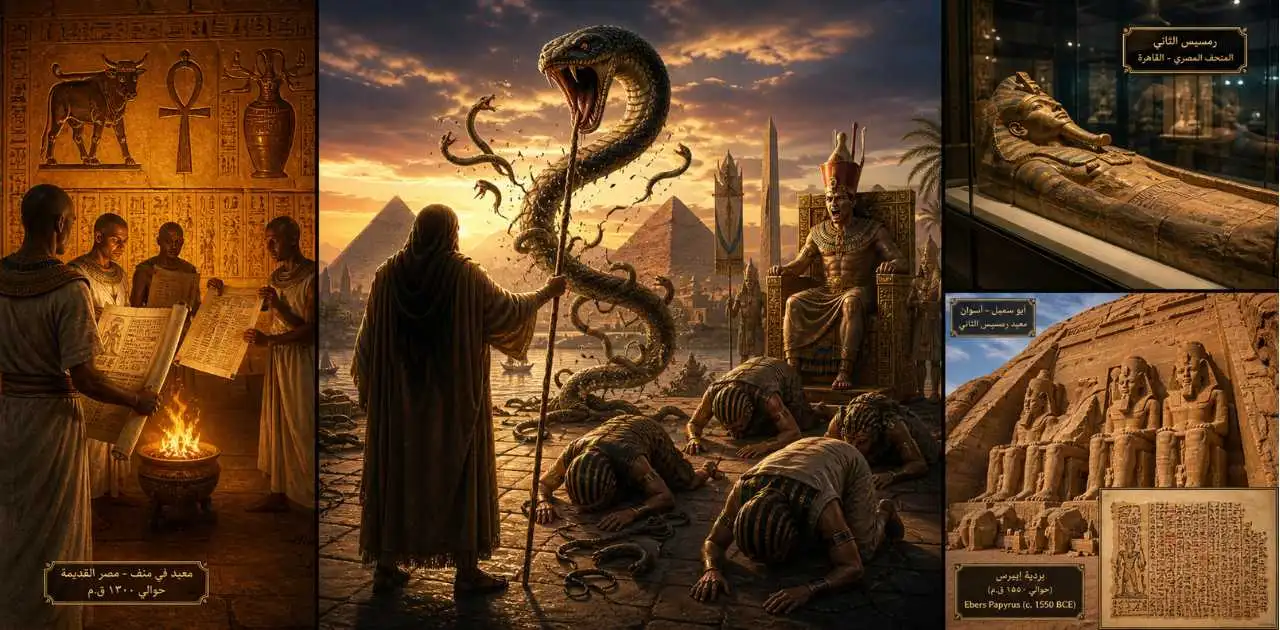
The Quran describes one of the most dramatic scenes in history. Pharaoh gathered the greatest sorcerers from across Egypt. They came with ropes and staffs that appeared to move like snakes through their jadoo.
“They said, ‘O Musa, either you throw, or we will be the first to throw.’ He said, ‘Throw.’ And when they threw, they bewitched the eyes of the people and struck terror into them, and presented a great act of magic.'” (Surah Al-A’raf 7:115-116)
Then Musa threw his staff:
“So We inspired to Musa, ‘Throw your staff.’ And at once it devoured what they were fabricating. So the truth prevailed, and what they were doing became vain.'” (Surah Al-A’raf 7:117-118)
The magicians didn’t just lose they converted. They fell prostrate, saying: “We have believed in the Lord of the worlds, the Lord of Musa and Harun.” (Surah Al-A’raf 7:121)
Pharaoh was furious. He threatened to crucify them. But they replied: “We do not prefer you over what has come to us of clear proofs.” (Surah Ta-Ha 20:72)
Popular Question Answered: What miracles did Prophet Musa perform against Pharaoh?
The staff turning into a real serpent (devouring fake ones), the shining hand (white without disease), nine clear signs (floods, locusts, lice, frogs, blood, drought, etc.), and finally the splitting of the sea.
Was Ramesses II the Pharaoh of Musa?
Popular Question Answered: Who was the Pharaoh during the time of Prophet Moses?
The chapter examines Ramesses II (ruled 1279–1213 BCE) as a prime candidate. Evidence includes:
- His mummy shows signs of a dramatic end possible drowning or trauma.
- Massive statues at Abu Simbel larger than the gods themselves scream divine arrogance.
- His body was moved multiple times from tomb to tomb, never finding peace exactly as Allah promised:
“So today We will save your body that you may be a sign for those after you. And indeed, many among the people are heedless of Our signs.” (Surah Yunus 10:92)
Ramesses II’s mummy is now in the National Museum of Egyptian Civilization in Cairo. Tourists stare at the face of the man who challenged Allah.
Popular Question Answered: What happened to Pharaoh’s body after drowning?
The Quran explicitly says Allah preserved it as a sign. The mummy of Ramesses II (or possibly Merneptah or another) shows that the body was recovered and mummified not lost at sea. That’s the miracle: a warning for all time.
The Golden Calf Mystery
Why did the Bani of Israel (Bani Israel) worship a calf right after escaping slavery? The answer traces back through Sumer, Mesopotamia, Zoroastrianism, even Indus Valley seals.
Popular Question Answered: Why did the Bani of Israel worship the golden calf?
They had spent centuries in Egypt, where the Apis Bull was worshipped as a living god symbol of power, fertility, and strength. When Musa went to Mount Tur (Koh-e-Tur) for 40 days, a man named Samiri (the Samaritan) collected their gold jewelry and fashioned a calf that emitted a sound (wind or mechanical trick). He said: “This is your god and the god of Musa but he forgot.” (Surah Ta-Ha 20:88)
Popular Question Answered: Who was Samiri in the story of the golden calf?
The Quran names him as the one who led Bani Israel astray. Some say he was from the people of Samarra (hence Samaritan). Others say he was a hypocrite who knew some magic from Egypt. His excuse: “I saw what they did not see… and I threw a handful of dust from the messenger’s footprint.” (Surah Ta-Ha 20:96) possibly referring to angel Jibreel’s horse.
Popular Question Answered: What cultural influences led to bull worship in ancient times?
It appears in Egypt (Apis Bull), Sumer (Bull of Heaven), Iran (Zoroastrianism’s bull sacrifice), Indus Valley (seals with bulls), Greece (Minotaur), and Hindu mythology (Nandi, Shiva’s bull). The bull represented raw power and virility a perfect idol for a people who forgot their Creator.
The Quran flips centuries of idol worship with one powerful hadith: On Judgment Day, the sun and moon will be thrown into Hell… in the form of a bull (Sahih Muslim 2952). What was worshipped becomes fuel.
Hieroglyphs, Hyksos, and the Ark of the Covenant
Popular Question Answered: What evidence is there for the Biblical/Quranic Exodus in archaeology?
The chapter discusses the Hyksos foreign rulers who invaded Egypt and were later expelled. Some scholars link the Hyksos expulsion (c. 1550 BCE) to the Exodus narrative. Also, hieroglyphs from the reign of Ramesses II mention slaves named “Mose” (meaning “born of” e.g., Amenmose, Ptahmose). Could one be Musa?
Popular Question Answered: What is the Ark of the Covenant in Islamic tradition?
Called Tabut-e-Sakina a wooden chest containing relics from Musa and Harun (peace be upon them). It brought sakinah (tranquility) to the Bani of Israel. The Quran mentions it in Surah Al-Baqarah 2:248 as a sign of kingship.
Abu Simbel Temples two massive rock temples built by Ramesses II. The main temple is dedicated to himself as a god. The smaller is for his queen Nefertari. When you see the statues, you understand why Allah sent Musa to break that arrogance.
Why Chapter 13 Matters
From Heka spells to divine serpents, from the Nile’s canals to the Red Sea’s parting, Chapter 13:
- Solves the mystery of Pharaoh’s identity (Ramesses II + others)
- Exposes the roots of magic in ancient Egypt (Ebers Papyrus, Book of the Dead)
- Traces the golden calf from Apis bull to Samiri’s deception
- Connects Quranic signs to preserved mummies and standing temples
Teaser for Chapter 14: What happened after the Exodus? The Bani of Israel wander, the Torah is revealed, and a golden calf still haunts them. Plus: The mysterious Samiri who was he really?
Popular Questions Answered in Chapter 13
- Who was the Pharaoh during the time of Prophet Moses? ✅ (Ramesses II candidate)
- What is the story of Prophet Musa in Islam? ✅ (Birth, palace, miracles, exodus)
- How did ancient Egyptians practice magic? ✅ (Heka, spells, Ebers Papyrus)
- What is the Book of the Dead in ancient Egypt? ✅ (Funerary spells collection)
- Who was Samiri in the story of the golden calf? ✅ (Samaritan, hoof dust)
- What evidence is there for the Exodus in archaeology? ✅ (Hyksos, Mose names)
- What was the role of the Nile River in Egyptian power? ✅ (Canals, agriculture)
- How did Pharaohs view themselves as gods? ✅ (Ramesses II statues)
- What is the Ebers Papyrus and its significance? ✅ (700 spells + medicine)
- Why did the Bani of Israel worship the golden calf? ✅ (Apis bull influence)
- What happened to Pharaoh’s body after drowning? ✅ (Preserved mummy)
- What miracles did Prophet Musa perform? ✅ (Staff, hand, nine signs, sea)
- What is the Ark of the Covenant in Islamic tradition? ✅ (Tabut-e-Sakina)
- How was ancient Egyptian society structured? ✅ (Pharaoh as divine)
- What cultural influences led to bull worship? ✅ (Global symbol of power)
Your Turn
Are you fascinated by ancient Egypt? Drop a 🏺 if you want more Quran meets archaeology. Comment your biggest question about Prophet Musa or Pharaoh. Share this with someone who loves Quranic stories + real history!