
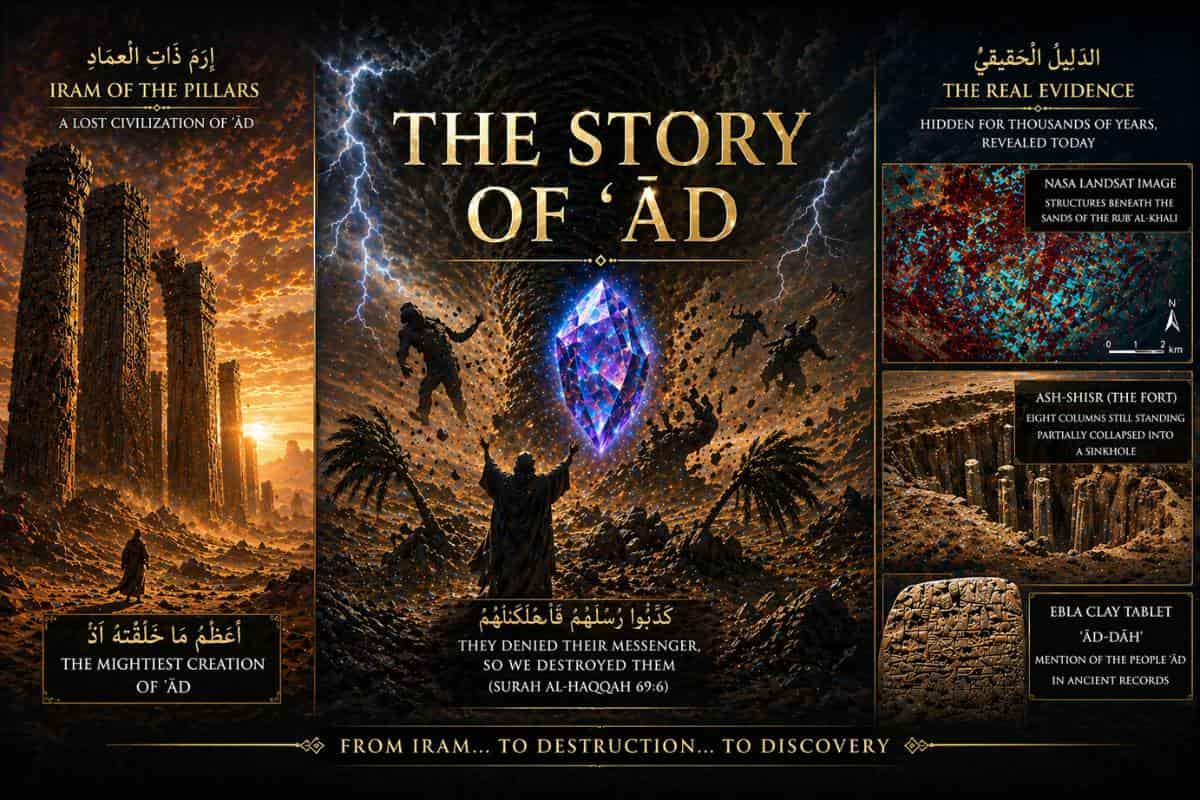
What if a legendary city with towering pillars unmatched in history, buried under endless sands wasn’t myth, but a Quranic warning? What if modern satellites and ancient tablets both testified to a nation so arrogant that Allah erased them with a wind that blew for eight days?
In Chapter 8: Lost City Of Iram And The People Of Qoum E Aad (Hazrat Hud, Allah Ka Azaab) of Chronicles of Unknown, we unearth the epic of Prophet Hud (A.S.), the arrogant ‘Aad nation, and their vanished metropolis. From the Rub’ al-Khali’s deadly dunes to the Ebla tablets of Syria archaeology echoes the Quran’s thunder.
This isn’t a fairy tale. It’s a grave.
Who Were the ‘Aad? Giants from Noah’s Lineage
After the Great Flood, humanity repopulated under Noah’s three sons. From Sam (Shem) came a grandson named Iram. And from Iram’s son, ‘Aad, rose a civilization of unmatched power.
The Quran doesn’t just mention them. It swears by them:
“Have you not considered how your Lord dealt with ‘Aad [with] Iram of the pillars, the like of which was not created in the lands?” (Surah Al-Fajr 89:6-8)
Think about that. Allah swears by a city. Iram of the pillars a name lost to history until the Quran preserved it. The ‘Aad were not ordinary people. Islamic tradition describes them as towering giants, blessed with:
- Lush gardens and flowing springs
- Treasures and fortresses
- Physical strength no nation before or since possessed
But pride poisoned them. They looked at their pillars, their wealth, their muscles and forgot the One who gave it all.
Prophet Hud: The Warner from Their Own Ranks
Allah sent Prophet Hud (A.S.) a man from the ‘Aad themselves. He knew their language, their customs, their pride. And he warned them with five desperate calls (repeated across the Quran):
“O my people, worship Allah; you have no deity other than Him. Then will you not fear Him?” (Surah Al-A’raf 7:65)
Their response? Arrogance dripping with mockery:
“You have only come to us that we should worship Allah alone and leave what our fathers worshipped. Then bring us what you promise us, if you should be truthful.” (Surah Al-A’raf 7:70)
When Hud warned of punishment, they sneered:
“We say that some of our gods have struck you with evil.” (Surah Hud 11:54)
Hud’s reply is a masterclass in tawheed:
“Indeed, I call Allah to witness, and you bear witness, that I am free from what you associate with Him other than Him. So plot against me all together; then do not give me respite.” (Surah Hud 11:54-55)
He didn’t flinch. He threw the challenge: Do your worst.
The Punishment: Winds That Tore Giants Apart
The ‘Aad demanded to see the punishment. They got it.
Allah sent a barren wind not the rain-bearing winds they knew, but a howling, merciless scream:
“Indeed, We sent upon them a screaming wind on a day of continuous misfortune. It was tearing people out as if they were trunks of uprooted palm trees.” (Surah Al-Qamar 54:19-20)
Eight days and seven nights (Surah Al-Haqqah 69:7). Imagine a hurricane that doesn’t stop for over a week. The wind didn’t just knock them down it uprooted them. Giants, proud men, women, children all thrown like straw.
The Quran describes five stages of punishment:
- Barren winds (no rain, no life)
- Black clouds (they thought it was rain it was death)
- Thunder
- Earthquake
- One final scream then silence
Today, their land is called Al-Ahqaf the “winding sand dunes” (Surah Al-Ahqaf 46:21) in the Rub’ al-Khali (Empty Quarter). A place where no Bedouin willingly camps. A place that still feels cursed.
Popular Question Answered: Where is Iram buried?
Under the sands of the Empty Quarter, straddling Yemen, Oman, Saudi Arabia, and the UAE. The Quran says: “So they were made nonexistent nothing remained except their dwellings” (Surah Al-Ahqaf 46:25).
Archaeology: From Bedouin Legend to Satellite Proof
For centuries, Western archaeologists dismissed Iram as myth. Then the evidence began piling up.
1. Ebla Tablets (4,000 years old, Syria)
Excavations at Ebla revealed cuneiform tablets listing trade partners. One name appeared: “‘Ād-dah” an early reference to the ‘Aad civilization. The Quran had preserved a name forgotten for millennia.
2. Bertram Thomas (1930s)
A British explorer crossed the Empty Quarter. His Bedouin guides whispered of “Iram” ruins deep in the sands of Hadramawt (modern Yemen). They called it “Atlantis of the Sands.”
3. Ash-Shisr Fort (1948 discovery, 1990s excavation)
A half-buried ancient fort in Oman’s dunes. When excavated, it revealed eight massive pillars, a collapsed central tower, and evidence of a sudden cataclysm possibly a sinkhole that swallowed the city.
4. NASA’s Landsat Satellites (1980s-1990s)
Infrared imaging showed ancient caravan routes converging on a single point in the Omani desert. Buried walls. A fortress layout consistent with “Iram of the pillars.”
5. 1992 NASA Expedition
Researchers from NASA and the Oriental Institute confirmed: The ruins matched ancient descriptions of Ubar (another name for Iram). Massive pillars. A city that collapsed into a limestone sinkhole possibly triggered by the divine punishment.
Popular Question Answered: Is Iram Atlantis?
No Atlantis is Greek legend. Iram is Quranic reality, confirmed by Ebla tablets, satellite imagery, and excavated pillars. But both were civilizations destroyed by their own arrogance.
Ali ibn Abi Talib’s Report: Hud’s Grave in the Red Dune
The fourth caliph, Ali ibn Abi Talib (may Allah be pleased with him) , reportedly said: “The grave of Hud is under a red dune in Hadramawt.”
Modern explorers have found exactly that: a massive red dune in the Hadramawt region of Yemen, avoided by locals, with ancient ruins nearby. No excavation has been permitted, but the alignment with Ali’s description is uncanny.
Sister Nation: Thamud The Camel, The Rock, and One Scream
The ‘Aad had cousins: Thamud (the people of Salih, peace be upon him). Their story is a mirror:
- They demanded a miracle: a pregnant she-camel emerging from solid rock (Surah Al-A’raf 7:73).
- Allah provided it. They were warned: Don’t harm her.
- Nine arrogant chiefs hamstrung the camel.
- Punishment: Three days of faces turning yellow, then red, then black then one scream (Surah Hud 11:67-68).
- They fell lifeless in their homes.
2018 Discovery: Saudi Arabia’s Al-Ula region revealed camel carvings 7,000-8,000 years old one clearly pregnant, appearing to emerge from the rock. The Quranic miracle, carved in stone before Islam.
The Prophet Muhammad (peace be upon him) forbade Muslims from drinking the water of Thamud’s wells during the Tabuk expedition. He even covered his face while passing through their valley. The curse was still fresh.
Popular Question Answered: Why did the Prophet ﷺ avoid Thamud’s wells?
As a lesson their punishment was a sign. Drinking from their water would blur the warning.
Why Chapter 8 Matters: From Ancient Pride to Modern Warnings
Chapter 8 isn’t ancient history. It’s a mirror.
The ‘Aad had:
- Advanced engineering (towering pillars)
- Economic power (caravan routes)
- Physical superiority (giants)
- Natural resources (gardens, springs)
But they lacked gratitude. They asked: “Who is stronger than us?” (Surah Fussilat 41:15) Allah answered: The One who created you.
Teaser for Chapter 9: Remember the winds that destroyed Iram? They were described as “pillar over pillar” echoing Iram’s own architecture. The next chapter explores: What were those pillars really for? And why did Allah use their own symbol against them?
Key Takeaways
| Nation | Prophet | Sin | Punishment | Modern Evidence |
| ‘Aad (Iram) | Hud | Pride, idol worship | 8-day barren wind | Ebla tablets, NASA satellites, Ash-Shisr pillars |
| Thamud | Salih | Killed she-camel | One scream | Al-Ula camel carvings, cursed wells |
Popular Questions Answered in Chapter 8:
- Where is Iram buried? ✅ Under Rub’ al-Khali dunes
- What does “pillars” mean? ✅ Massive fortresses, unmatched architecture
- How did NASA find Iram? ✅ Landsat satellites + caravan route mapping
- Were the ‘Aad really giants? ✅ Islamic tradition says yes physically imposing
- Is Iram in the Bible? ✅ No only the Quran preserved it
- Did anyone survive ‘Aad? ✅ Prophet Hud and the believers
- What are Ebla tablets? ✅ 4,000-year-old Syrian texts mentioning “‘Ād-dah”
- Why did Allah use wind? ✅ To mock their pride wind destroys pillars
- Is Rub’ al-Khali cursed? ✅ Local Bedouin avoid it “haunted” by ancient wrath
- What connects ‘Aad and Thamud? ✅ Both rejected prophets, both destroyed by screams
Your Turn
Is Iram the real “Atlantis of the Sands”? Have you seen the Rub’ al-Khali’s endless dunes?
Drop a 🏜️ if ancient ruins and Quranic archaeology excite you. Share this with someone who thinks the Quran is just poetry not historical proof.